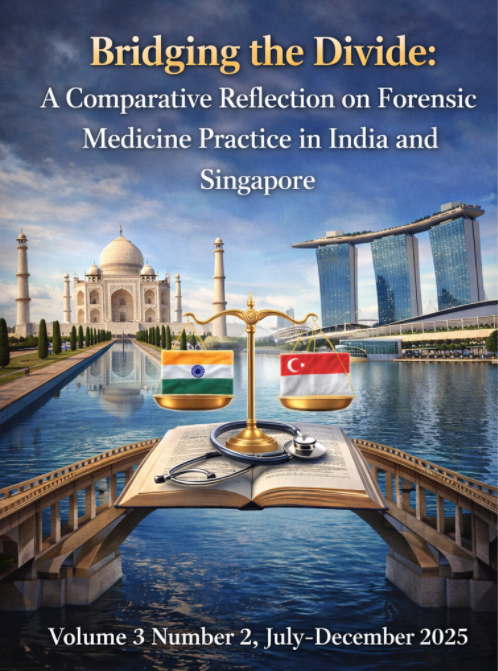
Original: Bridging the Divide: A Comparative Reflection on Forensic Medicine Practice in India and Singapore
DOI:
https://doi.org/10.5281/zenodo.17993303Keywords:
Forensic, Singapore, India, PracticeAbstract
Background: Although India and Singapore share a common medico-legal ancestry rooted in British colonial law, their forensic medicine systems have diverged significantly over time. India continues to follow a police-driven medico-legal framework under the Criminal Procedure Code (now BNSS), while Singapore has adopted a specialist-driven, coroner-based system supported by modern legislation, digital integration and strict accountability. This contrast provides important insights for strengthening forensic practice in India.
Methods: This narrative comparative analysis examines the historical evolution, legal frameworks, clinical forensic practices, autopsy systems, digital mortuary operations, professional autonomy and interagency collaboration in India and Singapore. Key legislative instruments, operational workflows and professional governance structures were reviewed and systematically compared.
Results: India retains a police-led inquest system where autopsies may be conducted by any authorized registered medical practitioner, leading to wide variability in quality, infrastructure and accountability. Clinical forensic examinations function largely under statutory authority with inconsistent implementation. Digital mortuary integration remains limited and fragmented.
Singapore operates under the Coroner’s Act 2010 with mandatory reporting of defined deaths, specialist-only autopsies, routine whole-body postmortem CT, and fully digitized mortuary operations using RFID-based tracking and integrated judicial databases. Strong interagency collaboration, specialist leadership, and performance-linked accountability ensure high scientific and judicial reliability.
Conclusion: The divergence between India and Singapore reflects deeper differences in governance, professional autonomy and institutional accountability within forensic medicine. While India possesses substantial academic strength and clinical exposure, the absence of national standardization, exclusive specialist authority and digital integration limits system efficiency and credibility. Adoption of key elements from the Singapore model—particularly a coroner-led framework, specialist-restricted autopsy practice, and national digital mortuary infrastructure—could significantly enhance the accuracy, transparency and judicial value of medico-legal evidence in India.
Downloads
Published
How to Cite
Issue
Section
License
Copyright (c) 2025 All content published in IJMJ is made available under the Creative Commons Attribution 4.0 International License (CC BY 4.0).

This work is licensed under a Creative Commons Attribution-NonCommercial 4.0 International License.
Copyright Policy Summary – International Journal of Medical Justice (IJMJ):
IJMJ is an open access journal. All articles are published under the Creative Commons Attribution 4.0 International License (CC BY 4.0). This allows others to freely access, share, reproduce, and create derivative works, provided proper credit is given to the original authors. Authors retain full ownership of their work.