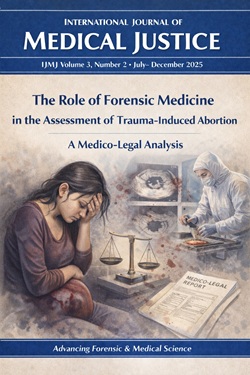
Review Article: The Role of Forensic Medicine in the Assessment of Trauma-Induced Abortion: A Medico-Legal Analysis
DOI:
https://doi.org/10.5281/zenodo.17993691Keywords:
Trauma Induced Abortion, Blunt Trauma, Expert TestimonyAbstract
Background: Trauma-induced abortion (TIA) presents a complex intersection of obstetrics, forensic medicine, and law. Establishing a causal link between alleged trauma and subsequent pregnancy loss is a critical medico-legal challenge, requiring rigorous scientific assessment to distinguish between spontaneous, illegal, and truly traumatic abortions.
Objective: This manuscript provides a comprehensive analysis of the role of forensic medicine experts in the evaluation of TIA. It examines the definitions, epidemiological factors, legal frameworks, standardized examination protocols, and the ethical imperatives that govern this specialized field.
Methods: A narrative review of the literature was conducted, synthesizing information from forensic medicine textbooks, peer-reviewed journals, and international guidelines. The focus was on evidence-based practices for examination, evidence collection, and interpretation of findings.
Results: Forensic medicine experts are pivotal in objectively correlating traumatic injuries with pregnancy loss. Their work involves a meticulous examination of the maternal-fetal unit, utilizing techniques from gross autopsy, histopathology, radiology, and toxicology. The interpretation of findings must be contextualized within specific legal statutes, such as the Medical Termination of Pregnancy Act, to determine culpability. Key challenges include the differentiation of accidental from intentional trauma, the variable latency between trauma and abortion, and navigating contentious socio-legal landscapes.
Conclusion: The forensic assessment of TIA is an indispensable component of the judicial process, providing critical, objective evidence to ascertain the facts. Strengthening interdisciplinary collaboration, developing standardized protocols, and advancing research into the biomechanics of pregnancy loss are essential future directions to enhance the accuracy and reliability of expert testimony in these sensitive cases.
Downloads
Published
How to Cite
Issue
Section
License
Copyright (c) 2025 All content published in IJMJ is made available under the Creative Commons Attribution 4.0 International License (CC BY 4.0).

This work is licensed under a Creative Commons Attribution-NonCommercial 4.0 International License.
Copyright Policy Summary – International Journal of Medical Justice (IJMJ):
IJMJ is an open access journal. All articles are published under the Creative Commons Attribution 4.0 International License (CC BY 4.0). This allows others to freely access, share, reproduce, and create derivative works, provided proper credit is given to the original authors. Authors retain full ownership of their work.