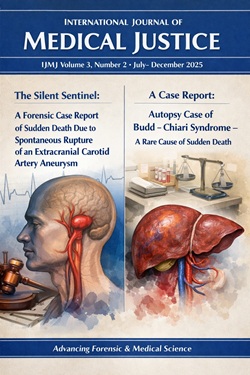
Case Report: Autopsy Findings in Fatal Budd-Chiari Syndrome – A Rare Cause of Sudden Death
DOI:
https://doi.org/10.5281/zenodo.17993577Keywords:
Budd-Chiari Syndrome, Hepatic Vein Thrombosis, Liver Cirrhosis, Portal Hypertension, Sudden DeathAbstract
Abstract: Budd-Chiari Syndrome (BCS) is a rare but life-threatening disorder characterized by the obstruction of hepatic venous outflow, which leads to hepatic congestion, portal hypertension, and potential progression to cirrhosis (Valla, 2009). Predisposing factors include hypercoagulable states, myeloproliferative disorders, and infections (Janssen, Garcia-Pagan, Elias, Mentha, & Valla, 2003). We present an autopsy case of a 24-year-old male, a known case of BCS complicated by Hepatitis C virus (HCV) infection and chronic liver disease, for whom liver transplantation was planned. The patient succumbed during medical management. The medico-legal autopsy revealed gynecomastia, micronodular liver cirrhosis, massive ascites, splenomegaly, esophageal varices, and bilateral pleural effusions. Histopathological examination confirmed cirrhotic architectural disruption. The immediate cause of death was determined to be hepatic failure secondary to BCS. This case underscores the aggressive natural history of BCS, particularly when compounded by concurrent HCV infection, and highlights the critical medico-legal role of autopsy in confirming the diagnosis and elucidating the pathophysiological sequence in rare, fatal presentations.
Downloads
Published
How to Cite
Issue
Section
License
Copyright (c) 2025 All content published in IJMJ is made available under the Creative Commons Attribution 4.0 International License (CC BY 4.0).

This work is licensed under a Creative Commons Attribution-NonCommercial 4.0 International License.
Copyright Policy Summary – International Journal of Medical Justice (IJMJ):
IJMJ is an open access journal. All articles are published under the Creative Commons Attribution 4.0 International License (CC BY 4.0). This allows others to freely access, share, reproduce, and create derivative works, provided proper credit is given to the original authors. Authors retain full ownership of their work.