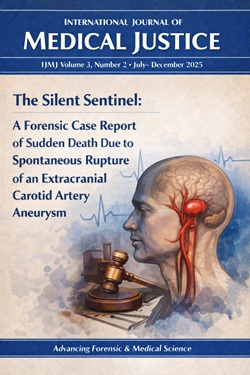
Case Report: The Silent Sentinel: A Forensic Case Report of Sudden Death Due to Spontaneous Rupture of an Extracranial Carotid Artery Aneurysm
DOI:
https://doi.org/10.5281/zenodo.17993398Keywords:
Carotid Artery,, aneurysm, carotid artery, rupture, sudden deathAbstract
Introduction: Extracranial carotid artery aneurysms (ECAAs) constitute a rare vascular pathology, accounting for <1% of all arterial aneurysms. Their clinical presentation is often asymptomatic, and spontaneous rupture is an exceptionally rare, frequently fatal event that can mimic suspicious death.
Case Presentation: We report the case of a 62-year-old hypertensive male with chronic alcoholism, discovered deceased in a locked hotel room. External examination revealed no signs of trauma. A comprehensive forensic autopsy identified approximately 500 ml of hemothorax, left ventricular hypertrophy, and micronodular cirrhosis. Critical findings included a ruptured saccular aneurysm (2.5 x 2 cm) of the left common carotid artery. Histopathological examination confirmed atherosclerotic degeneration of the vessel wall. The cause of death was established as hemorrhagic shock secondary to spontaneous ECAA rupture.
Discussion: This case underscores the medicolegal significance of ECAAs as a cause of sudden unexpected death. The primary etiologies—atherosclerosis and hypertension—were present in this individual, with chronic alcoholism potentially exacerbating vascular fragility. The absence of premonitory symptoms aligns with the documented silent progression of most ECAAs. A review of literature confirms the extreme rarity of spontaneous rupture but affirms its catastrophic potential. The autopsy served a critical dual purpose: elucidating a natural cause of death and excluding foul play, which was initially suspected due to the circumstances of discovery.
Conclusion: Spontaneous rupture of an ECAA, while rare, must be considered in the differential diagnosis of sudden unexplained death, particularly with findings of cervical or thoracic hemorrhage. This report highlights the indispensable role of meticulous forensic autopsy in distinguishing natural vascular catastrophes from unnatural deaths, thereby contributing to both medical knowledge and judicial clarity.
Downloads
Published
How to Cite
Issue
Section
License
Copyright (c) 2025 All content published in IJMJ is made available under the Creative Commons Attribution 4.0 International License (CC BY 4.0).

This work is licensed under a Creative Commons Attribution-NonCommercial 4.0 International License.
Copyright Policy Summary – International Journal of Medical Justice (IJMJ):
IJMJ is an open access journal. All articles are published under the Creative Commons Attribution 4.0 International License (CC BY 4.0). This allows others to freely access, share, reproduce, and create derivative works, provided proper credit is given to the original authors. Authors retain full ownership of their work.